
Private beta · by invitation

Do you control your agents?

Sirovi is a private software factory: a staff of AI engineers who work in your repository, on your machine, with your own Claude. You decide who they are, what they own and what they remember. Nothing sensitive leaves.

Every night the factory consolidates what your team learned into files in your repository. The model you rent will change. The experience stays yours, and it compounds from the day you start.

Developers only. How it works is explained below, in full, and in the eBook. Approved accounts hear from us by email.
The factory at work You hand a goal to a sphere of agents that organises itself; finished work ships out and only escalations come back to you. you a goal shipped escalations only AGENTS · SELF-ORGANISING SIROVI // FACTORY ONLINE LEARNING CYCLE · NIGHTLY
You bring the goal, the factory brings the hours, only escalations come back.

In your terminal

This is what control looks like.

Same request, same Claude Code, same repository, two ways to run it. Pick one.

Objective and team. You coordinate once and approve once. The team remembers, divides the work, reports a roadmap, checks its own code, and brings you only the decisions that are yours.

Control

An agent you do not control is a contractor with your keys.

Most teams now have agents touching their code. Few can say who those agents are, what they were told, what they remembered from last week, or why they did what they did. The output is in the pull request; the reasoning is gone, and the next run starts from zero.

Control is not a kill switch. It is knowing the answer to four questions, every day, for every agent on your team.

  • Who is this? A name, a role, a brief you wrote and can read back. Not a prompt someone pasted once.
  • What does it own? A scope with edges. The backend engineer does not rewrite your frontend because it felt helpful.
  • What does it remember? Lessons written as files in your repository, reviewed like code, kept or retired by you.
  • When does it ask me? A note on your desk when the decision is yours, with what it will do if you say nothing.

This matters more every month, because the agents are getting better faster than your ability to supervise them by reading diffs. Sirovi is built so that control grows with capability instead of shrinking.

Control is not a kill switch. It is knowing who, what, and when.

Process

We spent seventy years designing processes around human limits. Agents do not have them.

Sprints exist because people cannot sustain focus indefinitely. Standups exist because keeping a team in sync is expensive. Tickets, handoffs and review gates exist because no one can hold the whole system in their head. Agile is a brilliant set of workarounds for what humans cannot do.

When we started building agent systems, we copied the org chart: phases, gates, checklists, escalation paths. It worked, and it was a stepping stone. An agent does not lose focus at five o'clock, does not need a standup to know what its colleague did, and can read the whole codebase before lunch. Giving it a sprint is giving a bicycle to a fish.

The graph stops being something we author and becomes something assembled for the task at hand. Daniele Tassone, founder of Sirovi, in "We'll stop designing processes around human limits" on Every

A Sirovi factory runs the process agents deserve. Each colleague judges what it is good at and where it is likely to fail, decides whether to break a problem down, verify, bring in a teammate or call for you, and discards the plan when the job is done. Humans stay exactly where judgment and accountability live. An agent that knows its own limits will call for you more precisely than any fixed process ever did.

A process for humans

  • Fixed cadence, because attention runs out
  • Meetings, because context does not travel
  • Review gates, because memory is fallible
  • One plan for every task

A process for a factory

  • Work until the task is done, then stop
  • Shared memory, written down and reviewed
  • Verification chosen per task by the agent
  • A plan assembled for each job, then discarded

Agents write the code. Humans decide what is worth writing.

Where it runs

The factory runs on your machine, in your repository, with your Claude.

Sirovi is software you install into a repository you choose. It runs on your computer, inside your own Claude session, with your own Claude authentication. We never hold that authentication and your code never travels through our servers. What we provide is the factory itself and the service that staffs it; what it works on stays with you.

Your code never leaves your computer

On your computerOn Sirovi's servers
Reading your repositoryYour account and your team's organisation
Hiring: the tournament, the candidates, the judgingThe hire request, and the record that it was made
Every agent, as plain files you can readThe notes your colleagues leave you, so you can answer from anywhere
All the work the agents doUpdates to the factory software itself
Agent memory and lessons—
Your Claude authentication—
Your code, data, credentials and customer information—
Figure 3.1 Everything that touches your code stays on your computer. We hold your account, your hire requests and the notes your colleagues leave you; never your source, never your Claude authentication.

Three things you can hold us to: your source code is never uploaded to us, your Claude authentication never passes through us, and nothing is ever trained on your work.

We do not publish how the factory is built, and during the private beta that is deliberate. What we publish is where the boundary sits.

Your code never leaves. Neither does what your team learned.

Security

Safe because it is yours.

The factory, the agents and their memory are installed on your machine and live in your repository. Your code is never copied to our servers; the agents run on your own Anthropic key; and if we ever part ways, you keep the agents and everything they learned.

Read the security page
What you get

Safe for sensitive work. Under your control. Better every night.

Safe

Built for repositories you cannot share

Legal, finance, health, infrastructure: the code you would never paste into a chat window. The factory works where that code already lives and nothing leaves with it.

Yours

Colleagues you can read, review and retire

Every agent has a name, a brief, a scope and a memory, all as files in your repository. You see what they know, you decide what they keep, they ask before they decide for you.

Self-improving

A harness that learns while you sleep

Each night your staff consolidates what the day taught them and leaves you the changes to review in the morning. A factory that is six months old knows your codebase better than most new hires do.

A team, for example

The Backend guy Owns the API and the queue. Protects backward compatibility. On duty
The Tester girl Writes the tests that catch what the last incident taught her. Asleep, consolidating
The Reviewer Reads every pull request the way your strictest senior would. Waiting for your answer

Names, roles and habits are yours to set. These three are an example.

How it works

Hire and forge once. Work, sleep, evolve, every day.

Two steps once, when you hire. Three steps every day: the team works with you, sleeps, and comes back better. All of it on your machine; we only ever see that you asked for a colleague.

Hire and forge once; work, sleep and evolve every day

01

Hire

Describe the role. A tournament of up to fifty candidates runs on your machine, against your codebase.

up to 50 candidates · nothing leaves

02

Forge

The winner arrives as a pull request: a teammate you use in Claude like any agent, with a memory of their own.

a normal agent in Claude · with memory
03

Work

You assign objectives. The team plans, builds, checks its own code and brings you only the decisions that are yours.

you decide · they deliver
04

Sleep

Overnight the team holds its own retrospective and writes lessons down. Where they disagree with you, you get a 1:1 in the morning.

retrospective nightly · 1:1 on disagreement
05

Evolve

The harness improves itself from what the team learned. Versioned, reviewable, never uploaded.

self-improving · stays in your repository
Figure 5.1 Two stations run once, when you hire. Three run every day: the team works with you, sleeps, and comes back better. All of it inside your machine and your repository.

The agents bring the hours. You bring the why.

Your week

What you do in a week.

The question behind the eBook is what humans do in the era of AI. Here is the practical answer, for one owner of one factory. Everything not on this list, the agents do.

  1. Set the objective. One sentence: what is worth building this week, and why. The team turns it into a plan; you approve the plan, not the code.
  2. Approve or redirect. Pull requests arrive with their evidence: tests observed, not assumed. You merge, or you say what is wrong in one line.
  3. Answer the escalations. The agents bring you only the decisions that are yours: a trade-off, an unclear requirement, a risk. One or two a day, with their options and a default.
  4. Nothing. The factory sleeps: retrospective, consolidation, lessons written to your repository. You read them in the morning if you want to.
  5. The 1:1. Read the week's retrospective. Coach the hire that struggled. Hire for the gap you noticed. This is where your experience becomes theirs.

Your hours go to decisions. Theirs go to everything else.

Why Sirovi

Why Sirovi is different.

  1. Every agent is the winner of a two-hour hiring process. Not a prompt someone wrote on a Friday. Candidates are generated, interviewed and judged for your role before one is chosen, with the current best practices for prompt and context engineering built in and kept up to date, so briefing an agent and managing what it holds in context is practice, not folklore.
  2. A memory layer designed for a self-improving harness. Lessons are written once, found when they matter, verified against the code they describe, and retired when they stop being true.
  3. Team retrospective and a 1:1 with you. Every night the team reviews what the day taught them. You see what your agents think, and where they disagree with you, so that you can coach them. That is control over the reasoning, not only the output.
  4. A self-improving harness is your personal AGI. You know the factory. Sensitive data stays on your machine. What your team learns accumulates in files you own, and it is yours to keep when you leave us.

The model is rented. The experience is yours.

Benchmark

Accuracy holds as the task gets harder.

A generic agent and a Sirovi factory look alike on easy work. The gap opens with complexity, opens wider on tasks specific to your codebase, and becomes a different category altogether when the task runs for days.

Generic tasksWork any competent agent can attempt
100%50%0% lowhigh task complexity accuracy Generic agent, complexity 1 of 5: 95% (illustrative)Generic agent, complexity 2 of 5: 90% (illustrative)Generic agent, complexity 3 of 5: 82% (illustrative)Generic agent, complexity 4 of 5: 70% (illustrative)Generic agent, complexity 5 of 5: 55% (illustrative) Sirovi factory, complexity 1 of 5: 96% (illustrative)Sirovi factory, complexity 2 of 5: 94% (illustrative)Sirovi factory, complexity 3 of 5: 91% (illustrative)Sirovi factory, complexity 4 of 5: 88% (illustrative)Sirovi factory, complexity 5 of 5: 84% (illustrative) Sirovi factory Generic agent
Figure 8.1 Generic work: both start high, the generic agent falls with complexity.
Specialised tasksWork that needs your codebase, your rules, your history
100%50%0% lowhigh task complexity accuracy Generic agent, complexity 1 of 5: 88% (illustrative)Generic agent, complexity 2 of 5: 74% (illustrative)Generic agent, complexity 3 of 5: 58% (illustrative)Generic agent, complexity 4 of 5: 42% (illustrative)Generic agent, complexity 5 of 5: 30% (illustrative) Sirovi factory, complexity 1 of 5: 95% (illustrative)Sirovi factory, complexity 2 of 5: 93% (illustrative)Sirovi factory, complexity 3 of 5: 90% (illustrative)Sirovi factory, complexity 4 of 5: 86% (illustrative)Sirovi factory, complexity 5 of 5: 81% (illustrative) Sirovi factory Generic agent
Figure 8.2 Work that needs your codebase: memory and a defined role hold the line.
Long-horizon tasksOne objective, left running. Accuracy over elapsed time.
100%50%0% 1 h3 h6 h12 h1 day3 days7 days elapsed time, one objective accuracy Ordinary agent, after 1 h: 95% (illustrative)Ordinary agent, after 3 h: 62% (illustrative)Ordinary agent, after 6 h: 74% (illustrative)Ordinary agent, after 12 h: 48% (illustrative)Ordinary agent, after 1 day: 38% (illustrative)Ordinary agent, after 3 days: 26% (illustrative)Ordinary agent, after 7 days: 18% (illustrative) Sirovi factory, after 1 h: 96% (illustrative)Sirovi factory, after 3 h: 95% (illustrative)Sirovi factory, after 6 h: 95% (illustrative)Sirovi factory, after 12 h: 94% (illustrative)Sirovi factory, after 1 day: 93% (illustrative)Sirovi factory, after 3 days: 92% (illustrative)Sirovi factory, after 7 days: 91% (illustrative) Sirovi factory, 7 days and counting Ordinary agent context compacted, every ~3 h
Figure 8.3 One objective left running for a week. An ordinary agent loses the thread at every compaction.

Sirovi keeps a long objective in focus with a custom auto-compact algorithm and a memory engine built for long-horizon reasoning, and it can run up to seventy-five sub-agents in parallel on the same objective. An ordinary agent loses the thread every time its context is compacted, roughly every three hours.

Questions

Does my code go to your servers?

No. The factory runs on your machine and in your repository. We hold your account, your hire requests and the notes your colleagues leave you; never your source.

Do you see my Claude login?

No. The factory runs inside your own Claude, with the authentication already on your machine. It never passes through us.

Is this another coding assistant?

No. Assistants answer. A factory employs. Your staff has roles, memory and a review process, and keeps improving between your prompts.

Can I stop an agent?

Yes, the way you would stop a colleague: narrow its scope, retire a lesson, or let it go. Everything it is lives as files you own.

What does it cost?

The private beta is free for approved teams. Pricing is announced to the whitelist first.

When will I hear back?

We approve in batches and email each approved account directly. There is no position to check; the email is the signal.

Who we are

Built in-house, used every day, now yours.

Sirovi is a spin-off of Genie AI, a London startup backed by GV, Google's venture fund. We built the factory as an internal tool in January 2026 and it has run our own engineering ever since. It is battle-tested: we shipped 75 features to the product in less than three months. This is the road it took.

  1. The factory is born, as an internal tool.Built for one team: ours.
  2. Holographic memory.We tried the existing memory tools, and none of them let an agent keep what it learned. We built a new memory system and called it holographic memory.
  3. One technical layer, end to end.Sirovi could own a whole layer on its own: backend, or frontend, or AI.
  4. Team retrospective and the 1:1.The agents started reviewing their own work each night and bringing their disagreements to us. They began to outperform our engineers.
  5. The self-improving harness.Sirovi started teaching us about process and management. We deprecated Agile.
  6. Multi-stack, end to end.Frontend, backend, AI and testing in one objective, plus the process and the management around it.
  7. One week, 75 agents, a first product.Sirovi ran autonomously for a week, managing seventy-five agents, and built its first product end to end.
  8. Holographic memory v4.Once autonomous, the agents' memories grew faster than the system could hold. v4 lets them keep learning through their retrospectives and 1:1s.
  9. Sirovi runs the AI engineering department at Genie AI.Feature development, bug fixing, research and process, end to end.
  10. The pilot opens.We let a first group of potential customers run Sirovi on their own repositories. Join the whitelist to be among them.

The agents need your expertise. This is what we call compound engineering; you can call it the singularity moment. Train your agents: they learn very fast and they self-improve until they work as an extension of you. You are the decision maker.

Genie AI, London. Join the whitelist to run the same factory on your repository.
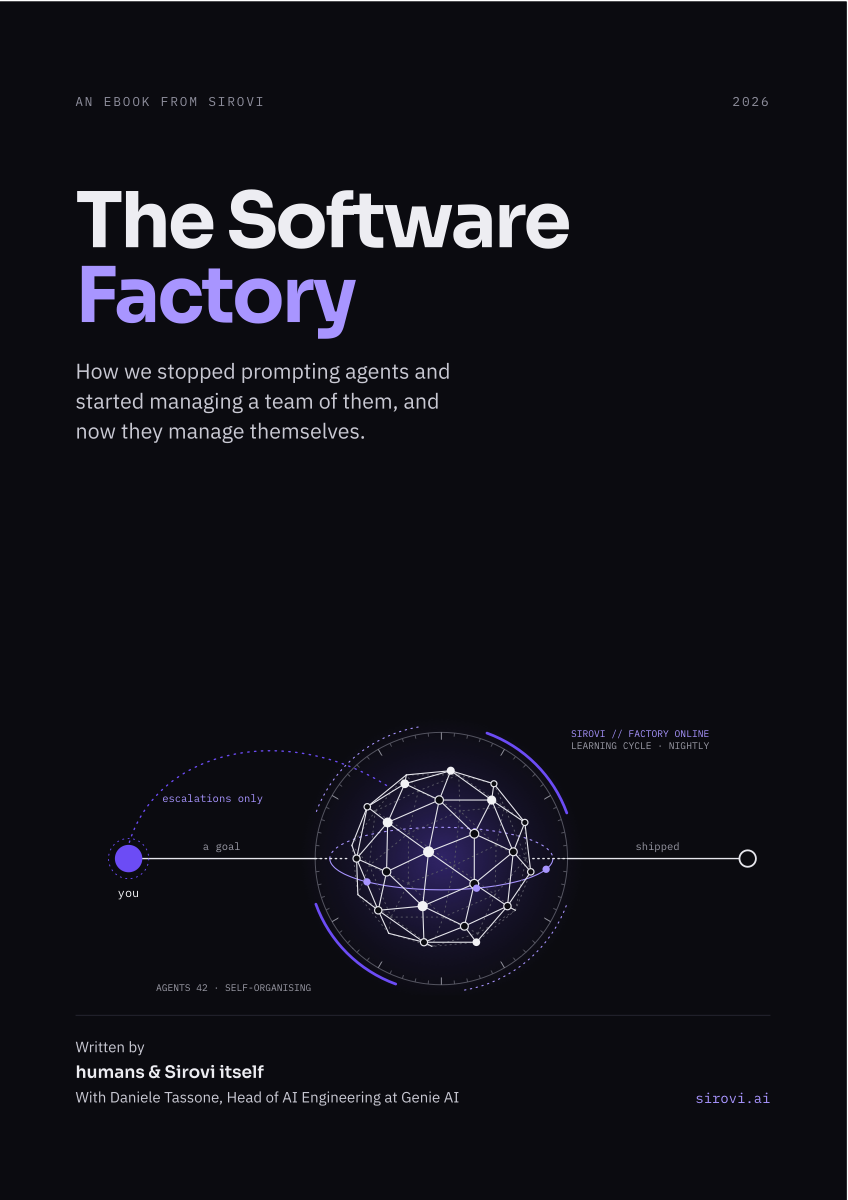
Free eBook · PDF

What is the role of humans in the era of AI? Read the ebook.

The Software Factory: how we stopped prompting agents and started managing a team of them, and now they manage themselves. About an hour, by humans and Sirovi itself.

Private beta

Join the whitelist.

We open the factory to a few teams at a time. Tell us who you are and we will write to you when your spot is ready, with an invitation for your company.

We use your email only to contact you about access. No newsletter.

Free eBook · PDF

The Software Factory

How we stopped prompting agents and started managing a team of them, and now they manage themselves.

For engineers who already use coding agents and have noticed that the hard part is no longer the code. Nine chapters from running a software factory at Genie AI, where a wrong answer is a legal problem. Where we tried something and it failed, we say so. About an hour to read.

By humans and Sirovi itself · 2026 · PDF

We use your email to send the book and to tell you when the pilot opens. No newsletter.